
Buildings / Envelope and roofs
Intelligence that
focuses the building.
Building envelope and roof inspection
Observe. Focus. Verify.
Read the whitepaper PDFFuture inspection concept
A vision for operator-supervised building-envelope and roof inspection. Connect an observation to the evidence that matters next.
Explore the approachThe next observation matters
Connect the building overview to a useful maintenance decision.
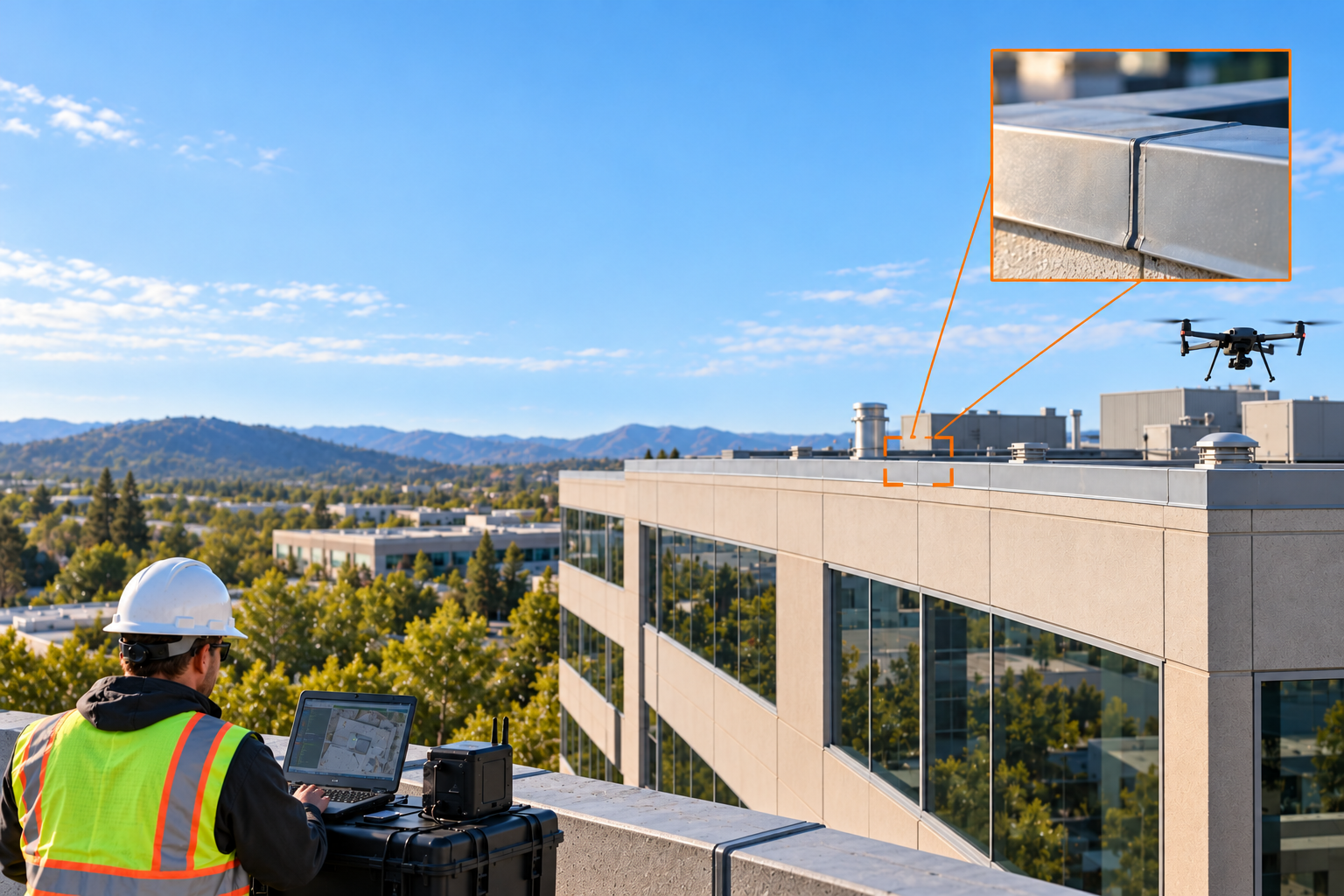
A building overview can reveal a surface change while leaving its meaning unresolved. A roof covering, flashing detail, façade joint or window perimeter may need another view, capture context or independent verification before a maintenance team can assess it.
Chimera’s direction connects broad observations to focused evidence collection for existing commercial and multifamily buildings. Local analysis would prepare the next useful observation; the operator would approve, modify or reject it. Qualified people would interpret the evidence and choose the maintenance response.
Roof observations
Give a roof observation a focused next step.
The opportunity is to relate accessible roof details to a defined inspection question and the evidence a qualified reviewer needs.
Roof coverings
Document visible surface changes, seams or displaced materials with their location and viewing conditions. An image does not establish the condition of concealed layers or confirm water entry.
Flashing and penetrations
Request a useful view around an accessible edge, transition or penetration. Retain the detail and its surrounding context for assessment rather than labelling it a leak source.
Drainage features
Record the visible condition of drains, gutters or outlets where accessible. Imagery can guide a review question; it does not prove drainage capacity or concealed blockage.
Apparent ponding
Relate a visible area of standing water to capture time, recent weather and relevant earlier observations. The view alone does not establish persistence, cause or structural significance.
A focused observation informs qualified review. Independent verification uses an appropriate method; it does not automatically require someone to access the roof.
Envelope observations
Keep the exterior detail attached to its building context.
The opportunity is to connect an accessible façade or window observation to its elevation, component and relevant records before a maintenance decision is made.
Façades and cladding
Retain visible surface changes and the surrounding elevation. Another viewpoint may clarify what is visible, while concealed connections and structural condition require their own assessment.
Joints and transitions
Record an apparent change around a joint or material transition and compare suitable reference imagery. Perspective, shadows and surface finishes can affect appearance.
Windows and perimeters
Focus on exterior components and accessible perimeter details from an approved viewpoint. Avoid unnecessary imagery through windows or of occupants; an exterior image does not establish air or water tightness.
Staining and surface changes
Locate unusual staining, discolouration or a changed finish for review. The observation does not establish moisture content, the origin of water or a concealed defect.
A qualified reviewer determines significance and any further assessment. This concept does not establish structural safety, code compliance or energy savings.
An adaptive inspection concept
See the building. Focus the next observation.
An intended workflow that connects observation, local analysis and operator-approved collection. Each follow-up begins with an inspection question.
- 01
Aircraft / payload
Observe.
Collect the agreed roof or exterior views and retain available time, location, weather and operating context. Frame the task around an accessible building detail.
Define the inspection question and permitted views first.
- 02
Chimera ground unit
Focus.
Bring a candidate observation into context and propose the additional view or reference needed. Keep visible detail separate from any compatible thermal observation.
A candidate observation is not a confirmed defect.
- 03
Operator
Authorise.
Review the proposed task against site permissions, people nearby, window exposure, safe viewpoints and aircraft constraints. Approve, modify or reject it.
The operator controls the action around an occupied building.
- 04
Aircraft / qualified team
Verify.
If authorised and appropriate, obtain a supported camera view or arrange a suitable independent assessment. Link the additional evidence to the original question.
Choose the verification method the question requires.
- 05Evidence informs the next observation
Reassess. Then continue.
A qualified reviewer records what the evidence supports, what remains uncertain and the appropriate next step. The disposition may be no further action, a targeted maintenance assessment or additional independent verification; it is not an automatic diagnosis.
Local intelligence. Human control.
Intelligence beside
the operator.
The proposed architecture places local analysis on a ground unit with the field crew. The aircraft collects evidence; the operator decides which supported action to authorise.
Aircraft
Available imagery
and telemetry
Chimera ground unit
Local analysis
and proposed collection
Operator
Approve, modify
or reject
An approved task returns through the supported aircraft interface. Additional evidence closes the loop.
Keep analysis close to the operation.
The intended analysis workflow runs locally without requiring cloud processing. Accessible imagery, telemetry and transfer timing still depend on a supported aircraft data connection.
Let the operating envelope shape the task.
A proposed action must fit the aircraft interface, flight plan and site constraints. Standoff, visibility, battery, link-loss and abort behaviour need to be established for the intended operation.
Building envelope & roof inspection inspection possibilities
Choose the evidence
the question needs.
Focus collection on the information that can move the review forward. Different tasks need different views, sources and levels of detail.
RGB imagery
Clarify the visible feature.
RGB imagery could document an accessible roof or façade feature and provide a complementary viewpoint. Resolution, distance, shadows, reflections and surface finishes affect what can be assessed. RGB cannot diagnose concealed moisture, internal defects or the condition of hidden layers.
Which view and reference would make the visible detail easier to assess?
Compatible thermal observations
Treat a thermal pattern as a question.
Suitable thermal equipment may reveal a surface-temperature pattern under appropriate capture conditions. Materials, emissivity, reflections, weather, solar loading and timing affect interpretation. A pattern alone does not confirm trapped moisture, a leak location, insulation performance or the cause of a difference; independent verification is required.
What else could explain this pattern, and how will it be checked?
Specialist verification
Match the method to the building question.
Qualified reviewers may need relevant drawings, prior observations, maintenance records or suitable independent assessment of the material or assembly. The method and safe access arrangements depend on the question. Specialist verification must not be reduced to an assumed roof visit or an unvalidated drone measurement.
Which independent evidence can support a maintenance decision?
The source mix depends on the inspection task and available interfaces. Complementary observations need not come from one aircraft or one flight.
From capture to a useful finding
Keep the evidence
with the decision.
A useful building record links the roof area or elevation, original imagery, capture conditions, requested evidence and reviewer disposition. Keep the visible observation distinct from its possible explanations and any independently verified finding.
Record what the evidence supports, who reviewed it and what still needs to be resolved.
Illustrative finding structure
- Reference
- Verified building, roof area or elevation; original image; actual capture time and available location and capture context.
- Question
- The candidate observation and the evidence needed to assess it.
- Response
- The requested follow-up and the operator’s decision.
- Evidence
- Additional imagery or observations linked to the original question.
- Assessment
- The reviewed finding or an unresolved evidence requirement.
Illustrative records
Two questions.
Two evidence trails.
These are example record structures, not recorded missions or measured results. The source, context and reviewer’s disposition remain visible at every step.
Illustrative record 01
A roof thermal pattern requiring independent verification
- Source imagery
- Illustrative compatible thermal observation of a roof area, paired with the corresponding RGB view. An operational record would retain the original sources and equipment settings, not only a coloured summary.
- Capture context
- Record the actual time, roof reference, equipment, relevant material information and weather and capture conditions. This example contains no real temperature, moisture value or measured result.
- Question
- What could explain the apparent surface-temperature pattern, and which independent check would help distinguish those explanations?
- Requested evidence
- Review the matching RGB image, relevant prior records and capture suitability. A qualified team would choose appropriate independent verification and safe access arrangements; the pattern alone does not identify moisture or a leak.
- Reviewer disposition
- Illustrative status: requires independent verification. Record the outstanding question and responsible reviewer; do not mark a confirmed leak, trapped moisture or repair outcome.
Illustrative record 02
A visible façade-joint change requiring qualified assessment
- Source imagery
- Illustrative RGB view of a changed-looking joint on an exterior elevation. An operational record would retain both the detailed image and the wider component and elevation context.
- Capture context
- Record the actual capture time, verified elevation or component, viewpoint, lighting and available reference imagery. No real defect severity, displacement measurement or event is represented.
- Question
- Does the visible difference warrant maintenance assessment, or could viewpoint, light or surface appearance explain it?
- Requested evidence
- If appropriate, obtain an operator-approved complementary exterior view and relevant drawings or maintenance records. Respect people nearby, window privacy and the agreed operating envelope.
- Reviewer disposition
- Illustrative status: awaiting qualified assessment. The reviewer would record the supported observation and next action; the image does not establish structural significance, concealed failure or code compliance.
The foundation and the direction
Build from evidence.
Validate for the task.
This paper describes future inspection possibilities for existing commercial and multifamily buildings, not a recorded Chimera building deployment. Construction progress remains a separate application. No defect-detection performance, confirmed leakage or moisture, structural conclusion, code compliance or energy saving is claimed.
Any pilot would need an agreed question, supported aircraft and sensors, representative reference observations and qualified review. Existing agricultural case-study evidence does not validate roof or envelope performance. A thermal pattern remains a screening observation until independently checked.
Define the question and operating envelope.
Agree the building area, maintenance question and review owner. Establish site and flight permissions, arrangements for occupied buildings and people nearby, window privacy, safe viewpoints and appropriate access for any independent assessment.
Confirm equipment and capture conditions.
Check aircraft and sensor compatibility, source imagery access, location context and suitable capture conditions. For thermal work, document equipment settings and relevant materials, reflections, weather and timing.
Establish references and qualified review.
Use independently assessed reference observations and suitable supporting records. Review false alerts, missed observations and unresolved cases without treating each visible or thermal candidate as a confirmed defect.
Evaluate whether follow-up helps.
Assess whether the additional evidence answers the original maintenance question and remains traceable to its sources. Record the reviewer’s disposition and remaining uncertainty; measure usefulness before making performance or savings claims.
Sources and context
Ground the question
in the right guidance.
These references inform the inspection boundaries and evidence choices. They do not constitute endorsement of Chimera or validation of this proposed workflow.
- U.S. Department of Energy — Building envelope
Background on building-envelope systems and their role in building performance. This general context is not evidence of Chimera performance or projected savings.
- FLIR — How to detect a water leak with thermal imaging
Explains the role and limits of temperature observations when investigating possible moisture. Thermal patterns require appropriate interpretation and independent verification; they do not directly measure moisture or establish a leak location.
Explore the whitepaper
What should your
next observation answer?
Explore the possibilities, then bring us your inspection question, aircraft and evidence requirements.
Chimera Innovation Inc. · Victoria, BC
info@chimera.vision