
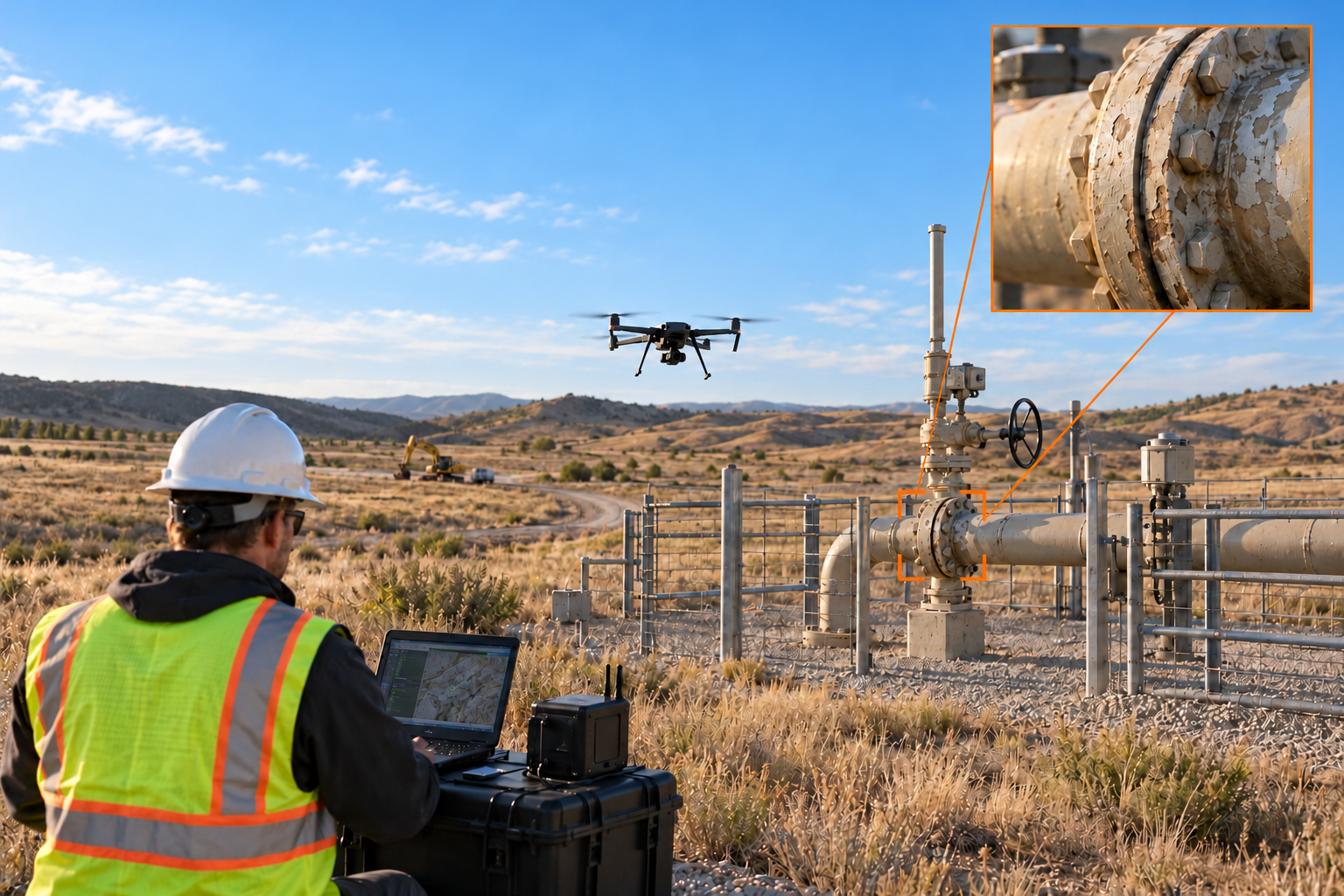
Energy / Oil pipelines
Intelligence that
focuses the corridor.
Oil-pipeline security and condition awareness.
Observe. Focus. Verify.
Read the whitepaper PDFFuture inspection concept
A vision for operator-supervised pipeline security and condition awareness. Connect an observation to the evidence that matters next.
Explore the approachThe next observation matters
Connect the patrol view to the next decision.
A corridor patrol can reveal activity near the right-of-way or a visible change at an exposed asset. The important question is what that observation means—and which evidence would help the team decide.
Chimera’s direction connects broad observations to purposeful follow-up. Local analysis would prepare a focused evidence request; the operator would approve, modify or reject it. This concept addresses land-based corridors, exposed pipework, valves and pump stations for pipeline operators, security teams and maintenance teams.
Physical security
Understand the activity before escalating it.
The opportunity is to bring an observation and its operational context together, so security teams can decide which activity needs an authorization check or further review.
Activity near the corridor
Relate visible people, vehicles or equipment to the relevant work area and approved activity. Presence alone does not establish wrongdoing.
Excavation equipment
Record the observed equipment and its location context for comparison with current work permissions and the operator’s damage-prevention process.
Access-point changes
Compare an observed gate or access route with an appropriate reference. A different appearance may have an authorised explanation.
Damaged fencing
Retain the visible condition and request a useful view for review. The image alone does not establish cause, intent or an intrusion.
People verify permissions and choose the response. The concept does not include autonomous pursuit or automated accusations.
Condition awareness
Turn a visible change into an inspection question.
The opportunity is to connect accessible surface observations to maintenance review. A closer image can clarify a feature; it does not replace specialist integrity assessment.
Coating and unusual staining
Capture visible coating changes or unusual staining on exposed pipework and nearby surfaces. Imagery alone cannot establish the cause, contents or integrity of the pipe.
Supports and fittings
Record apparent changes around an accessible support, valve or fitting and compare with the relevant asset record. Qualified review determines significance.
Erosion and exposed pipe
Locate visible ground change or newly exposed pipe for assessment. Imagery does not establish cover depth, ground stability or the condition of buried sections.
Possible release indicators
Unexpected pooling, a sheen or other visible change may warrant escalation. These observations have multiple possible causes and do not confirm a release.
A suspected release follows the operator’s emergency procedures. It must not automatically trigger a closer flight or approach.
An adaptive inspection concept
Observe the corridor. Focus the evidence.
An intended workflow that connects observation, local analysis and operator-approved collection. Each follow-up begins with an inspection question.
- 01
Aircraft
Observe.
Capture the agreed corridor or exposed asset area, retaining source imagery and available capture time, location and mission context.
Begin with an agreed patrol and inspection question.
- 02
Chimera ground unit
Focus.
Bring a candidate observation into context and propose the evidence still needed. Flag whether permissions, asset records or a qualified assessment are required.
A candidate is not a confirmed threat or defect.
- 03
Operator
Authorise.
Review the evidence request against the mission, work permissions and operating constraints. Approve, modify or reject it; route suspected releases into emergency procedures.
No automatic close approach to a suspected release.
- 04
Aircraft / field team
Verify.
If appropriate and authorised, use a supported camera action, safe viewpoint or specialist follow-up to gather the required evidence.
The question and operating conditions determine the method.
- 05Evidence informs the next observation
Reassess. Then continue.
Link the new evidence to the original observation. The responsible reviewer records what is supported, what remains uncertain and whether to close the record, request further assessment or escalate through the operator’s established process.
Local intelligence. Human control.
Intelligence beside
the operator.
The proposed architecture places local analysis on a ground unit with the field crew. The aircraft collects evidence; the operator decides which supported action to authorise.
Aircraft
Available imagery
and telemetry
Chimera ground unit
Local analysis
and proposed collection
Operator
Approve, modify
or reject
An approved task returns through the supported aircraft interface. Additional evidence closes the loop.
Keep analysis close to the operation.
The intended analysis workflow runs locally without requiring cloud processing. Accessible imagery, telemetry and transfer timing still depend on a supported aircraft data connection.
Let the operating envelope shape the task.
A proposed action must fit the aircraft interface, flight plan and site constraints. Standoff, visibility, battery, link-loss and abort behaviour need to be established for the intended operation.
Oil pipelines inspection possibilities
Choose the evidence
the question needs.
Focus collection on the information that can move the review forward. Different tasks need different views, sources and levels of detail.
RGB imagery
Understand the visible scene.
RGB images could document corridor activity, visible surface changes, exposed fittings and access conditions. Resolution, lighting and viewpoint limit interpretation. These images cannot see through soil or diagnose internal corrosion.
Which visible detail and reference would clarify the observation?
Compatible thermal observations
Assess temperature with context.
Suitable thermal observations may help investigate a defined temperature question when capture conditions, emissivity, reflections and equipment limitations are understood. Conventional thermal imaging is not a generic oil-leak or gas detector; a temperature contrast does not identify the substance or cause.
Is the equipment appropriate, and what could explain the contrast?
Specialised sensing and assessment
Use the method the question requires.
Certain gas-detection tasks require compatible optical gas imaging or other specialised sensing matched to the target substance and operating conditions. Internal pipe condition requires appropriate integrity methods, such as in-line inspection where applicable. Any future sensor integration would need task-specific validation.
Which validated method and qualified reviewer can answer this question?
The source mix depends on the inspection task and available interfaces. Complementary observations need not come from one aircraft or one flight.
From capture to a useful finding
Keep the evidence
with the decision.
A useful pipeline record links the original observation, its time and location context, the requested evidence and the reviewer’s disposition. Keep physical-security observations and condition concerns traceable without turning either into an unsupported conclusion.
Record what the evidence supports, who reviewed it and what still needs to be resolved.
Illustrative finding structure
- Reference
- Corridor segment or verified asset reference, original image and available capture time and location context.
- Question
- The candidate observation and the evidence needed to assess it.
- Response
- The requested follow-up and the operator’s decision.
- Evidence
- Additional imagery or observations linked to the original question.
- Assessment
- The reviewed finding or an unresolved evidence requirement.
Illustrative records
Two questions.
Two evidence trails.
These are example record structures, not recorded missions or measured results. The source, context and reviewer’s disposition remain visible at every step.
Illustrative record 01
Corridor activity requiring an authorization check
- Source imagery
- Illustrative broad RGB view of excavation equipment near the corridor. An operational record would retain the original image and a focused crop, rather than only a summary.
- Time and location
- Record the actual capture timestamp, corridor reference and available position accuracy. No real event, time or coordinates are asserted in this example.
- Question
- Does the observed activity correspond to authorised work in this area and time window?
- Requested evidence
- Compare the observation with current work permissions and the operator’s designated contact. If authorised and appropriate, request a wider contextual view from an approved viewpoint.
- Reviewer disposition
- Illustrative status: awaiting an authorization check. The responsible team would record the verified context and choose to close, continue review or escalate under its process. No wrongdoing is inferred.
Illustrative record 02
An unusual condition near exposed pipework
- Source imagery
- Illustrative RGB observation of unusual staining near an exposed fitting. An operational record would retain the uncropped source and the asset context.
- Time and location
- Record the actual capture timestamp, verified asset reference and available location context. No actual incident or measured result is represented.
- Question
- What does the visible change represent, and what assessment is required to determine its significance?
- Requested evidence
- Check relevant prior imagery and maintenance records. The operator determines whether a safe additional view or specialist assessment is appropriate; a suspected release goes directly into emergency procedures.
- Reviewer disposition
- Illustrative status: unresolved condition concern. A qualified reviewer would document the evidence and required next action. The observation does not establish leakage, corrosion or remaining integrity.
The foundation and the direction
Build from evidence.
Validate for the task.
This paper presents future possibilities, not a recorded Chimera pipeline deployment. It makes no claim of proven detection performance, guaranteed protection or autonomous response. It addresses physical security and accessible land-based assets, not cybersecurity or offshore and subsea inspection.
Any pilot would need an agreed operating envelope, supported aircraft and data interfaces, suitable sensors, representative reference observations and qualified reviewers. Existing agricultural case-study evidence does not validate pipeline security or integrity performance.
Define the question and operating envelope.
Select a physical-security or condition-awareness question, relevant permissions, escalation owner and acceptable follow-up actions. Establish how suspected releases and other urgent concerns enter existing procedures.
Confirm equipment and reference evidence.
Agree aircraft and sensor compatibility, imagery access, positioning needs and capture conditions. Establish independently reviewed reference observations suitable for the intended task.
Evaluate observations and human decisions.
Review false alerts, missed observations and unresolved cases against the agreed reference. Record how permissions checks and qualified assessment affect the disposition, without treating every candidate as a confirmed issue.
Assess the value of follow-up.
Check whether the additional evidence answers the original question and remains traceable. Use the results to decide which uses merit further validation; do not promise a performance threshold before measurement.
Sources and context
Ground the question
in the right guidance.
These references inform the inspection boundaries and evidence choices. They do not constitute endorsement of Chimera or validation of this proposed workflow.
- Canada Energy Regulator — Damage prevention
Context for activities near pipelines and damage-prevention responsibilities. Operators must apply the requirements relevant to their location and operation.
- PHMSA — Pipeline leak recognition and what to do
Possible release indicators and response guidance. An aerial observation is not a release diagnosis; the operator’s emergency procedures govern suspected events.
- PHMSA — In-line inspection (smart pigs)
Background on specialist internal pipeline assessment. Surface imagery does not substitute for an appropriate integrity inspection method.
- FLIR — Can you see toxic emissions with thermal cameras?
Explains why gas imaging depends on suitable spectral sensitivity and target gases. Conventional thermal imagery must not be treated as generic leak detection.
Explore the whitepaper
What should your
next observation answer?
Explore the possibilities, then bring us your inspection question, aircraft and evidence requirements.
Chimera Innovation Inc. · Victoria, BC
info@chimera.vision